
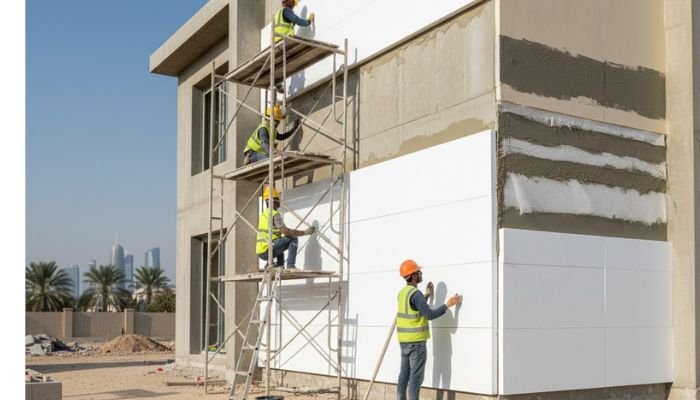
Introduction: EPS Insulation Board in Qatar Construction
Thermal insulation board (EPS expanded polystyrene panels) is the cornerstone of effective building envelope design in Qatar. These rigid foam panels provide the thermal resistance needed to combat extreme desert heat while offering superior cost-effectiveness, ease of installation, and proven long-term performance.
At Insugreen, we specify and install EPS insulation board across hundreds of Qatar projects annually, from residential villas to commercial developments. This comprehensive guide covers everything you need to know about EPS insulation board: specifications, applications, installation methods, performance data, and selection criteria for optimal results in Qatar’s challenging climate.
Whether you’re an architect specifying insulation systems, a contractor planning installation, or a building owner evaluating options, understanding EPS insulation board capabilities ensures you achieve maximum energy efficiency and building comfort.
What is Thermal Insulation Board?
Thermal insulation board is a manufactured rigid foam panel made from expanded polystyrene. The boards consist of millions of closed air cells that resist heat transfer, providing R-values of 3.6 to 4.5 per inch of thickness.
Manufacturing Process: Polystyrene beads are pre-expanded with steam, then molded into blocks under heat and pressure. The blocks are cut into boards of specified dimensions using hot wire cutting for precision.
Standard Board Composition:
- Material: 98% air, 2% polystyrene
- Density: 10-35 kg/m³ depending on application
- Cell structure: Closed-cell foam (each bead is sealed)
- Flame retardants: Integrated during manufacturing
Why Boards vs. Other Forms: EPS insulation board offers advantages over spray-applied or loose-fill insulation including consistent thickness and R-value, quality verification before installation, predictable performance, easier handling and storage, and precise dimensional tolerancing.
Thermal Insulation Board Specifications
Board Dimensions and Sizes
Standard Sizes:
- 600mm × 1200mm (most common for wall applications)
- 1000mm × 1000mm (economical for large areas)
- 1000mm × 2000mm (reduces seams in tall walls)
- Custom sizes available for specific project requirements
Thickness Range:
- Minimum: 20mm (limited applications)
- Standard: 50mm, 75mm, 100mm, 150mm
- Maximum: 300mm (custom order)
- Increments: Available in 10mm steps
Edge Profiles:
- Square edge: Standard, lowest cost
- Tongue and groove: Reduces thermal bridging at joints
- Shiplap edge: Easier alignment during installation
- Beveled edge: For decorative applications
Density Classifications for EPS Insulation Board
Type I EPS (10-15 kg/m³):
- R-value: 3.6-3.8 per inch
- Compressive strength: 40-70 k Pa
- Best for: Non-load-bearing wall insulation, decorative elements
- Cost: Lowest, approximately 12-18 QAR/m² for 50mm thickness
Type II EPS (15-20 kg/m³):
- R-value: 3.8-4.2 per inch
- Compressive strength: 70-100 k Pa
- Best for: EIFS wall systems, standard building envelope
- Cost: Mid-range, approximately 18-27 QAR/m² for 75mm thickness
- Most common specification for Qatar residential projects
Type VIII EPS (20-25 kg/m³):
- R-value: 4.2-4.4 per inch
- Compressive strength: 100-135 k Pa
- Best for: Roof deck insulation, under-slab applications
- Cost: Higher, approximately 27-38 QAR/m² for 75mm thickness
Type IX EPS (25-35 kg/m³):
- R-value: 4.4-4.5 per inch
- Compressive strength: 135-200 k Pa
- Best for: Heavy load applications, parking decks, plaza decks
- Cost: Premium, approximately 36-50 QAR/m² for 100mm thickness
Material Performance Specifications
Thermal Conductivity: Maximum 0.036 W/(m·K) at 10°C mean temperature for Type II EPS insulation board
Water Vapor Permeability: 3-5 perms for 1 inch thickness (breathable, allows vapor diffusion)
Water Absorption: Less than 3% by volume after 24-hour immersion
Dimensional Stability: ±0.5% over temperature range -50°C to +75°C
Flame Spread Rating: Class A or Class 1 per ASTM E84 when treated with flame retardants
Service Temperature Range: -50°C to +75°C (well beyond Qatar climate extremes)
Applications of Thermal Insulation Board in Qatar
Application 1: External Wall Insulation Systems
The primary use of EPS insulation board in Qatar is external wall insulation in EIFS configurations. Boards are adhered to exterior walls, covered with reinforced base coat and finish coat.
Typical Wall Assembly:
- Existing concrete/block wall
- Adhesive layer
- EPS insulation board (75-100mm Type II)
- Mechanical fasteners
- Base coat with embedded fiberglass mesh
- Finish coat (acrylic or silicone)
Performance: R-12 to R-16 thermal resistance, 75-85% reduction in wall heat gain, 25-40 year system lifespan
Cost: 120-180 QAR/m² complete installed system
Energy Impact: Reduces cooling costs by 40-60% for walls, payback period 5-8 years
This remains the most cost-effective approach to improving building envelope performance in Qatar. For complete installation details, see our EIFS installation guide.
Application 2: Cavity Wall Insulation
For new construction with cavity walls, EPS insulation board fills the air gap between wythes of masonry or concrete.
Installation Method:
- EPS insulation board placed in cavity during wall construction
- Board thickness: 50-75mm (limited by cavity width)
- Boards cut to fit between wall ties
- Joints staggered to minimize thermal bridging
Advantages: Insulation protected from weather and UV, no exterior appearance change, integrates with standard construction practice
Limitations: Cavity width limits insulation thickness, difficult to retrofit in existing buildings, requires careful detailing to prevent moisture accumulation
Performance: R-8 to R-12 depending on board thickness, less effective than external insulation but better than no insulation
Application 3: Roof Deck Insulation
EPS insulation board can insulate flat concrete roof decks, though spray foam is often preferred for this application.
Installation Sequence:
- Concrete roof deck
- Vapor barrier (if needed)
- High-density EPS insulation board (Type VIII or IX)
- Separation layer (geotextile fabric)
- Waterproof membrane
- Ballast (gravel) or pavers
Board Specification: 100-150mm thickness, 20-35 kg/m³ density to support foot traffic and maintenance loads
Advantages: Lower cost than spray foam, easy to replace damaged sections, provides flat surface for membrane installation
Disadvantages: Multiple boards needed for thick insulation, potential for gaps between boards, requires separate air sealing layer
Verdict: Use EPS insulation board for roofs when budget constraints exist or when board system specified for other reasons. For optimal roof performance, spray foam’s superior air sealing justifies cost premium.
Application 4: Foundation and Perimeter Insulation
EPS insulation board insulates foundation walls and slab edges to prevent thermal bridging and reduce heat transfer from ground.
Foundation Wall Application:
- Type II EPS insulation board (15-20 kg/m³)
- Board thickness: 50-75mm
- Installed on exterior of foundation wall
- Protects waterproofing membrane from thermal stress
- Extends below grade to frost line (not applicable in Qatar)
Slab Edge Application:
- Vertical EPS insulation board at perimeter of floor slabs
- Prevents thermal bridging at slab-wall junction
- Typical thickness: 50mm
- Reduces edge heat loss by 70-80%
Benefits: In Qatar climate, foundation insulation provides 5-10% additional energy savings when combined with wall and roof insulation. More important for thermal comfort than energy savings.
Application 5: Under-Slab Insulation
For ground-level slabs, EPS insulation board reduces heat transfer from ground while providing stable base for concrete placement.
Installation Details:
- Compacted sub-base prepared to proper grade
- High-density EPS insulation board (Type VIII, 20-25 kg/m³)
- Board thickness: 50-75mm
- Vapor barrier over EPS insulation board
- Concrete slab poured directly over assembly
Performance Benefits: Reduces ground heat transfer by 60-80%, maintains floor surface temperature closer to space temperature, improves comfort in ground-floor areas, reduces cooling load by 10-15% for ground floor
Cost Consideration: Adds 30-50 QAR/m² to slab construction. Include in new construction for sustainable building performance. Less economical to retrofit.
Selecting the Right Thermal Insulation Board
Determining Required Thickness
Target R-Values for Qatar:
- Walls: R-12 to R-16 (75-100mm Type II EPS)
- Roofs: R-20 to R-30 (125-200mm depending on density)
- Under-slab: R-8 to R-12 (50-75mm Type VIII EPS)
- Foundation walls: R-8 to R-12 (50-75mm Type II EPS)
Thickness Calculation: R-value needed ÷ R-value per inch = inches of insulation required
Example: Wall target R-15. Using Type II EPS (R-4.0 per inch): 15 ÷ 4.0 = 3.75 inches = 95mm. Select standard 100mm board thickness.
Choosing Appropriate Density
For Vertical Wall Applications: Type II (15-20 kg/m³) provides optimal balance of thermal performance and cost. Higher density adds expense without significant benefit for non-load-bearing applications.
For Roof Applications: Type VIII or IX (20-35 kg/m³) required to support maintenance traffic and equipment loads without compression damage.
For Under-Slab Applications: Type VIII minimum (20-25 kg/m³) to support concrete weight and building loads.
For Foundation Walls: Type II (15-20 kg/m³) sufficient as no significant compressive loads exist.
Edge Profile Selection
Square Edge: Lowest cost, adequate for most applications. Use when budget is primary concern and slight thermal bridging at joints is acceptable.
Tongue and Groove: Reduces thermal bridging by 15-20% compared to square edge. Worth the 10-15% cost premium for high-performance buildings.
Shiplap: Easier installation alignment. Select when labor costs are high or installation speed is critical.
Recommendation: Use tongue-and-groove EPS insulation board for walls when targeting maximum energy performance. Use square edge when cost constraints exist and thermal bridging can be managed through proper installation technique.
Installation Methods for Thermal Insulation Board
Adhesive Application Method
Adhesive Type: Polymer-modified cement-based adhesive specifically formulated for EPS. Never use solvent-based adhesives which dissolve polystyrene.
Application Pattern – Ribbon and Spot:
- Apply continuous ribbon of adhesive around board perimeter (50mm from edges)
- Apply 5-6 dollops (each approximately 100mm diameter) in center area
- Total coverage: 40-60% of board area
- Press board firmly to wall achieving full contact
Coverage Verification: Test panels by attempting to pull board from wall after adhesive cure. Foam should tear before adhesive bond fails. If boards pull clean, increase adhesive coverage.
Curing Requirements: Adhesive must reach initial set (2-4 hours) before mechanical fasteners installed. Allow minimum 24 hours cure before applying base coat.
Mechanical Fastening
Fastener Types:
- Plastic plate fasteners with stainless steel or galvanized screws
- Plate diameter: 50-60mm to distribute load
- Screw length: Board thickness + substrate embedment (minimum 25mm into concrete)
Fastener Density:
- Standard: 4-6 fasteners per 600mm × 1200mm board
- High wind areas: 6-8 fasteners per board
- Corners and edges: Increased density per manufacturer specifications
Installation Technique:
- Pre-drill pilot holes through EPS insulation board
- Drive fasteners until plate is flush with foam surface
- Do not over-tighten (compresses foam creating dimples)
- Stagger fastener pattern to avoid stress concentration
Joint Treatment and Air Sealing
Board Fit: Cut EPS insulation board accurately to achieve maximum 3mm gaps between boards. Larger gaps create thermal bridges and telegraph through finish coats.
Gap Filling: Fill gaps over 6mm with EPS adhesive or compatible low-expansion foam. Never stuff gaps with loose foam scraps (creates voids and weak points).
Joint Staggering: Install boards in running bond pattern (offset joints like brickwork). Avoid four-corner joints which create stress concentrations.
Corner Details: Use full boards at corners. Interlock boards at inside and outside corners for maximum strength and minimal thermal bridging.
Thermal Insulation Board vs. Alternative Materials
Thermal Insulation Board vs. XPS Board
EPS Advantages:
- 30-40% lower material cost
- Breathable (allows vapor diffusion preventing moisture accumulation)
- More environmentally friendly (no HFC blowing agents)
- Proven long-term performance without thermal drift
XPS Advantages:
- Higher R-value per inch (R-5.0 vs. R-4.0)
- Superior moisture resistance
- Higher compressive strength at same density
Verdict for Qatar: EPS insulation board preferred for above-grade wall applications. Cost savings significant, vapor permeability prevents moisture issues, and R-4.0+ meets Qatar requirements. Reserve XPS for below-grade or high-moisture applications where its properties justify cost premium.
Thermal Insulation Board vs. Mineral Wool Board
EPS Advantages:
- Higher R-value per inch (R-4.0 vs. R-3.0-3.5)
- Lower cost (40-50% less expensive)
- Lighter weight (easier handling)
- Better moisture resistance
Mineral Wool Advantages:
- Non-combustible (inherently fire-resistant)
- Better sound absorption
- No flame retardant additives needed
Verdict for Qatar: EPS insulation board delivers superior thermal performance and cost-effectiveness for building envelope. Use mineral wool only when fire rating requirements cannot be met with EPS plus fire-rated coverings, or when acoustic performance is priority.
Thermal Insulation Board vs. Polyurethane/Polyisocyanurate Board
EPS Advantages:
- 40-60% lower cost
- No thermal drift over time (maintains rated R-value)
- Vapor permeable (prevents moisture accumulation)
- 100% recyclable
Polyurethane/Polyiso Advantages:
- Higher R-value per inch (R-6.0-7.0)
- Thinner insulation achieves same thermal resistance
- Foil facings provide vapor barrier and radiant barrier
Verdict for Qatar: For most applications, EPS insulation board cost-effectiveness outweighs polyurethane’s higher R-value. Space constraints rarely exist in Qatar construction, so EPS thickness is not limited. Use polyurethane only when space is truly constrained or when project budget allows premium materials.
Cost Analysis: Thermal Insulation Board Systems
Material Costs (Qatar Pricing)
EPS Insulation Board Only:
- Type II, 50mm: 12-18 QAR/m²
- Type II, 75mm: 18-27 QAR/m²
- Type II, 100mm: 24-36 QAR/m²
- Type VIII, 75mm: 27-38 QAR/m²
Installation Materials:
- Adhesive: 8-12 QAR/m²
- Mechanical fasteners: 4-6 QAR/m²
- Base coat and mesh: 12-18 QAR/m²
- Finish coat: 15-30 QAR/m²
Complete System Installed Costs
EPS Insulation Only (Adhesive + Fasteners + Labor):
- 50mm system: 35-50 QAR/m²
- 75mm system: 45-65 QAR/m²
- 100mm system: 55-75 QAR/m²
Complete EIFS System (Including Finish Coats):
- 75mm EPS complete: 120-160 QAR/m²
- 100mm EPS complete: 140-180 QAR/m²
Return on Investment: Typical Qatar villa (280m² wall area) with 75mm EPS insulation board system costs 33,600-44,800 QAR installed. Annual energy savings: 4,500-6,000 QAR. Simple payback: 5.6-10 years. Over 25-year system life, net savings exceed 70,000-100,000 QAR.
Quality Control for Thermal Insulation Board
Material Inspection
Density Verification:
- Request certified density test reports from manufacturer
- Random sampling: Weigh boards and calculate density (weight ÷ volume)
- Accept tolerance: ±10% of nominal density
Dimensional Tolerance:
- Thickness: ±2mm
- Length/width: ±3mm
- Squareness: Maximum 3mm deviation from 90° over 1200mm length
Visual Inspection:
- Check for cracks, voids, or manufacturing defects
- Verify uniform cell structure
- Confirm flame retardant treatment (specified color tint)
- Reject damaged or contaminated boards
Installation Quality Verification
Adhesive Coverage Check:
- Pull test on sample boards after adhesive cure
- Minimum 40% coverage required
- Foam must tear before adhesive bond fails
- If boards pull clean, reject installation and increase coverage
Joint Quality:
- Maximum 3mm gaps between boards
- No gaps over 6mm unfilled
- Running bond pattern maintained
- No four-corner joints
Fastener Installation:
- Correct fastener type and density
- Plates flush with foam surface (not over-driven)
- Proper embedment into substrate
- No missing or damaged fasteners
Surface Flatness:
- Maximum 6mm deviation over 3 meter span
- No waves, bulges, or hollows
- Smooth transitions at thickness changes
- Ready for base coat application
Performance Verification
Thermal Imaging: Infrared camera inspection after installation identifies gaps, missing insulation, thermal bridges, and installation defects. Essential quality assurance tool.
Blower Door Testing: Whole-building air leakage testing verifies air sealing effectiveness. Target: Less than 3 air changes per hour at 50 Pa pressure differential.
Energy Monitoring: Track actual energy consumption post-installation to verify predicted savings achieved.
Long-Term Performance and Maintenance
Durability and Service Life
R-Value Stability: EPS insulation board maintains rated thermal resistance indefinitely. No thermal drift or gas loss occurs over time (unlike some closed-cell foams using blowing agents).
Dimensional Stability: Properly installed EPS insulation board does not shrink, warp, settle, or develop gaps. Maintains full coverage for building life.
Moisture Resistance: Closed-cell structure limits water absorption to less than 3% by volume. Does not support mold growth. Performance not affected by occasional wetting if allowed to dry.
UV Resistance: EPS degrades under direct UV exposure. Must be protected by cladding or finish coats. When protected, service life exceeds 50 years with no maintenance.
Maintenance Requirements
Annual Inspection:
- Visual inspection for cracks, damage, or deterioration
- Check joint sealants and terminations
- Inspect finish coat for any damage
- Verify no water intrusion or moisture staining
Periodic Cleaning:
- Wash finish coat with low-pressure water and mild detergent every 2-3 years
- Remove any algae, mildew, or staining
- Never use high-pressure washing (damages finish)
Repair Needs:
- Small cracks: Seal with elastomeric sealant
- Impact damage: Cut out damaged area, patch with new EPS and refinish
- Finish coat renewal: Apply fresh finish coat every 15-20 years to extend life
Expected Maintenance Costs: Less than 5 QAR/m² per year for routine maintenance. Major refinishing at 15-20 years costs 25-40 QAR/m² (fraction of new installation cost).
Environmental Considerations
Sustainability Profile
Manufacturing Impact: EPS production uses less energy than most alternative insulation materials. Modern manufacturing does not use CFCs or HCFCs (no ozone depletion).
Material Composition: 98% air, 2% polystyrene. Very low material use per unit of insulation provided.
Service Life Impact: 50+ year service life means one-time manufacturing impact amortized over decades of energy savings.
Recyclability: EPS insulation board is 100% recyclable. Clean waste can be densified and reformed into new products. Many manufacturers offer take-back programs.
End-of-Life Options: Recycle, reuse as aggregate or fill material, thermal recovery (energy from waste). Chemically stable – does not leach harmful substances in landfill.
Energy Payback Period
Manufacturing Energy: EPS insulation board manufacturing consumes approximately 25-35 k Wh per m³ of foam produced.
Energy Saved: 75mm EPS wall insulation in Qatar saves approximately 150-200 k Wh/m² annually in cooling energy.
Energy Payback: Manufacturing energy recovered in first 1-2 months of use. Remaining 50+ year service life is pure energy gain.
Carbon Impact: Over 25-year life, EPS insulation board prevents 50-75 times more CO₂ emissions than produced during manufacture and installation.
FAQ: Thermal Insulation Board for Qatar Projects
What thickness of EPS insulation board is recommended for Qatar walls?
For residential walls, 75mm Type II EPS insulation board is standard, providing R-12 thermal resistance. This reduces wall heat gain by 75-80% at optimal cost-performance. High-performance projects may specify 100mm for R-16. Minimum 50mm recommended – thinner provides inadequate performance in Qatar climate.
How long does EPS insulation board last?
Properly installed and protected EPS insulation board maintains full insulation value for 50+ years. The foam does not degrade, compress, or lose R-value over time. System lifespan is typically limited by finish coat (15-25 years) rather than insulation itself, but finish can be renewed to extend total life to 40+ years.
Is EPS insulation board fire-safe?
EPS contains flame retardant additives and meets Class A or Class 1 flame spread requirements when tested per ASTM E84. However, it remains combustible and must be protected by fire-rated coverings (cement board, gypsum board, EIFS coatings) per building codes. When properly covered, EPS insulation board poses no greater fire risk than other foam insulations.
Can EPS insulation board get wet?
EPS absorbs less than 3% water by volume even with prolonged immersion. Brief wetting from rain during construction or occasional water exposure in service does not damage the foam or significantly affect performance. Must dry before covering with impermeable finishes. For prolonged moisture exposure, use XPS instead.
What is the cost difference between EPS and spray foam insulation?
For achieving R-12 to R-16 wall insulation, EPS insulation board costs 45-65 QAR/m² installed versus 80-140 QAR/m² for spray foam. EPS delivers equivalent thermal performance at 40-60% lower cost for flat wall surfaces. Spray foam’s cost premium is justified for roof applications and irregular surfaces where its properties provide unique benefits.
How do I prevent thermal bridging with EPS insulation board?
Use tongue-and-groove edge profile (reduces thermal bridging by 15-20%), stagger joints in running bond pattern, fill all gaps over 3mm with adhesive or sealant, use continuous insulation on exterior (eliminates concrete thermal bridges), and detail window/door openings with continuous insulation wrap. Thermal imaging verification after installation identifies any remaining thermal bridges.
Can EPS insulation board be installed in humid climates like coastal Qatar?
Yes. EPS vapor permeability is actually beneficial in humid climates, allowing moisture to diffuse through rather than accumulate. This prevents condensation issues common with vapor-impermeable insulations. For coastal locations, ensure proper drainage details and use high-quality finish coats to prevent water infiltration at surface.
Is EPS insulation board environmentally friendly?
Yes. EPS has favorable environmental profile: no CFCs/HCFCs in modern manufacture, 98% air content (minimal material use), 50+ year service life (one-time impact), 100% recyclable, prevents 50-75 times more CO₂ than manufacturing emissions through energy savings. Energy payback in 1-2 months of use makes it highly sustainable choice.
Why Choose Insugreen for Thermal Insulation Board Systems
- Qatar’s leading provider of EPS insulation board solutions
- Premium materials from top manufacturers with verified specifications
- Certified installation crews trained in proper EPS application
- Complete EIFS systems integrating insulation with durable finishes
- Thermal modeling to optimize board thickness and density
- Quality control with thermal imaging verification
- Competitive pricing through volume purchasing
- Full system warranties covering materials and workmanship
- Energy performance guarantees based on actual monitoring
- Ongoing support and maintenance services
For comprehensive building envelope solutions, we integrate EPS insulation board wall systems with spray foam roof insulation for maximum performance.
Explore our complete range of insulation solutions at our services page or review completed projects across Qatar.
Conclusion: Thermal Insulation Board – Proven Performance for Qatar Buildings
Thermal insulation board represents the optimal balance of thermal performance, cost-effectiveness, and installation practicality for Qatar building envelopes. With R-values of 3.8-4.5 per inch, service life exceeding 50 years, and installed costs 40-60% lower than spray foam alternatives, EPS delivers maximum value for wall insulation applications.
For architects, contractors, and building owners seeking proven, cThe versatility of EPS insulation board – available in multiple densities, thicknesses, and edge profiles – enables optimization for every application from EIFS wall systems to foundation insulation. Proper specification and professional installation deliver consistent 40-60% reductions in cooling energy with payback periods of 5-8 years.
ost-effective insulation solutions, EPS insulation board remains the material of choice for Qatar’s demanding climate and aggressive construction schedules.
Contact Insugreen today for EPS insulation board specification assistance and project pricing. We’ll analyze your requirements and provide detailed recommendations optimized for your building’s performance goals and budget.
For comprehensive information on sustainable building approaches and energy saving methods, explore our complete resource library.