
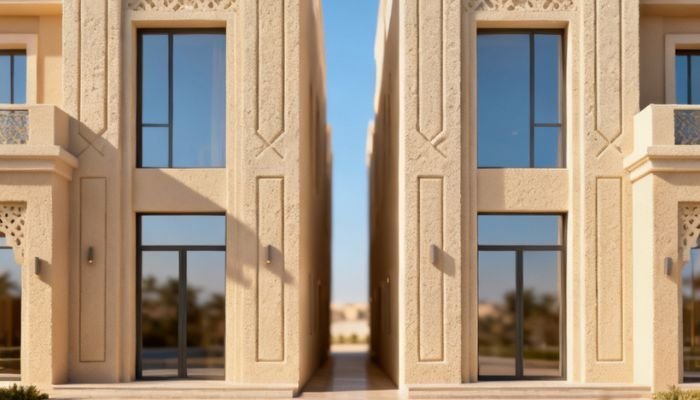
Introduction: EPS Foam Revolutionizes Facade Design
Architectural facade design in Qatar traditionally relied on heavy materials like stone, concrete, and plaster to create decorative elements—an approach that added significant weight and cost to buildings while limiting design flexibility. EPS (Expanded Polystyrene) foam panels have revolutionized facade design, enabling architects and designers to create sophisticated architectural features including cornices, columns, window frames, and decorative moldings at 40-70% lower cost and less than 5% of the weight of traditional materials.
At Insugreen, we’ve transformed hundreds of Qatar building facades using EPS foam architectural elements combined with EIFS (External Insulation and Finishing Systems). This approach delivers dual benefits: stunning visual impact through unlimited design possibilities, plus superior thermal performance reducing cooling costs by 45-65%.
This comprehensive guide explores how EPS foam architectural elements enable modern and classical facade designs while providing thermal insulation, structural advantages, and long-term durability in Qatar’s demanding climate.
What is Architectural Facade Design with EPS Foam?
Architectural facade design with EPS foam involves creating decorative building exterior elements from lightweight expanded polystyrene, then coating them with protective cement-based finishes. The EPS foam boards are precision-cut using CNC machines or hot wire tools to create any architectural profile, then installed on building facades and finished to match desired aesthetics.
Key Components:
EPS Foam Core: Expanded polystyrene provides the structural base. Density 15-25 kg/m³ is standard for architectural elements, offering optimal balance of workability, strength, and cost.
Reinforced Base Coat: Polymer-modified cement coating 3-5mm thick, reinforced with alkali-resistant fiberglass mesh, creates durable weatherproof surface.
Finish Coat: Acrylic, silicone, or mineral-based finish coat 1-3mm thick provides final color, texture, and UV protection. Can replicate stone, marble, brick, or any desired finish.
Integration with EIFS: Architectural elements integrate seamlessly with EIFS wall systems, creating unified facade combining thermal performance with aesthetic appeal.
Architectural Elements Possible with EPS Foam
Cornices and Crown Moldings
Cornices are horizontal decorative elements running along the top of walls where they meet roofs or between building floors. Traditional stone or concrete cornices weigh 150-300 kg per linear meter and cost 800-1,500 QAR/m installed. EPS foam cornices weigh 5-15 kg per linear meter and cost 280-550 QAR/m installed.
Design Flexibility:
- Simple classical profiles (cove, dentil, egg-and-dart)
- Complex multi-layer crown moldings
- Modern minimalist horizontal bands
- Ornate baroque or neoclassical designs
Standard Dimensions:
- Projection from wall: 150-600mm typical
- Height: 200-800mm typical
- Custom sizes: Unlimited
Installation: EPS foam cornices attach with adhesive and mechanical fasteners, spanning large sections with minimal joints due to lightweight construction. Traditional materials require heavy structural support; foam cornices need only standard wall attachment.
Durability: Properly finished foam cornices last 25-40 years in Qatar climate with minimal maintenance. The lightweight construction eliminates sagging or structural issues common with heavy traditional materials.
Columns and Pilasters
Decorative columns create classical elegance or modern vertical emphasis. Traditional columns require massive structural support due to weight. EPS foam columns are purely decorative (not load-bearing) but create identical visual impact at fraction of cost and weight.
Column Types:
- Full round columns (Classical orders: Doric, Ionic, Corinthian)
- Half-round columns attached to walls
- Pilasters (flat decorative columns)
- Square or rectangular columns
- Tapered columns
Components:
- Base (bottom decorative element)
- Shaft (main column body – can be fluted or smooth)
- Capital (top decorative element)
Typical Specifications:
- Diameter: 200-600mm common
- Height: 2,000-8,000mm typical
- Weight: 15-80 kg per column (vs. 800-3,000 kg for stone)
- Cost: 1,200-4,500 QAR per column installed (vs. 5,000-20,000 QAR for stone)
Design Advantage: CNC cutting creates perfect classical proportions. Fluted columns, ornate capitals, and intricate details impossible or prohibitively expensive in stone become economical with EPS foam.
Window and Door Surrounds
Window frames, door frames, and architectural surrounds add sophistication to otherwise plain openings.
Standard Elements:
- Window sills (horizontal bottom element)
- Lintels (horizontal top element)
- Side jambs or pilasters (vertical elements)
- Keystones (decorative center element at top)
- Pediments (triangular or arched top element)
Design Options:
- Simple rectangular frames
- Classical architrave designs
- Ornate Victorian or baroque frames
- Modern minimalist reveals
Cost Comparison:
- EPS foam window surround: 180-450 QAR per window
- Stone window surround: 800-2,200 QAR per window
- Savings: 60-75% using EPS foam
Practical Benefit: Lightweight surrounds don’t stress window frames or wall structures. Easy replacement or modification without structural concerns.
Quoins and Corner Accents
Quoins are decorative corner blocks creating visual interest at building corners. Traditionally cut from stone with alternating sizes creating textured pattern.
EPS Foam Quoins:
- Typical size: 200-400mm face × 150-300mm projection
- Alternating large/small pattern
- Cost: 45-95 QAR per block installed
- Weight: 1-3 kg per block (vs. 30-80 kg for stone)
Application: Attached to building corners with adhesive and fasteners, finished to match or contrast with main wall finish.
Decorative Brackets and Corbels
Brackets (corbels) are support-like elements under eaves, balconies, or windows. While structurally unnecessary with modern construction, they add classical architectural character.
EPS Foam Advantages:
- Intricate carved details economical through CNC cutting
- Lightweight installation under any overhang
- Weather-resistant when properly finished
- Cost: 120-380 QAR each installed
Balustrades and Railings
Decorative railings for balconies, terraces, and roof parapets can be created from EPS foam when structural requirements are met separately.
Design Components:
- Balusters (vertical spindles)
- Top rail (handrail)
- Bottom rail
- Newel posts (end or corner posts)
Application Notes: EPS foam balustrades are decorative cladding over structural railing system. The foam elements create visual impact while structural metal provides required safety.
Cost Advantage: Classical stone balustrades cost 1,200-2,500 QAR per linear meter. EPS foam balustrade cladding costs 350-750 QAR per linear meter.
Decorative Bands and String Courses
Horizontal bands running across facades divide floors or create visual interest.
Types:
- Simple flat bands (50-200mm projection)
- Molded decorative bands with profiles
- Belt courses between floors
Installation: Long continuous runs with minimal joints. Lightweight construction allows spanning large sections.
Cost: 85-220 QAR per linear meter installed
Combining Thermal Performance with Aesthetics
The revolutionary aspect of EPS foam architectural facade design is dual functionality: decorative elements simultaneously provide thermal insulation.
EIFS System Integration
When architectural elements integrate with complete EIFS wall systems, buildings achieve:
Thermal Performance:
- 75mm EIFS base insulation: R-12 to R-15 thermal resistance
- Architectural elements add local R-value where installed
- Continuous insulation eliminates thermal bridges
- 40-60% reduction in wall heat gain
Aesthetic Achievement:
- Unlimited design possibilities
- Perfect integration between flat walls and decorative elements
- Unified finish coat creates seamless appearance
- Modern or classical styling as desired
Cost Effectiveness:
- Combined system costs 120-180 QAR/m² for complete facade
- Includes full insulation plus architectural details
- 50-70% less than stone facade
- 30-50% less than brick with stone details
Example Project: Qatar villa with 280m² facade area
- EIFS base system: 75mm insulation + finish = 100 QAR/m² × 280m² = 28,000 QAR
- Architectural elements: 4 columns, window surrounds, cornices = 12,000 QAR
- Total: 40,000 QAR installed
- Stone equivalent: 95,000-140,000 QAR
- Annual cooling savings: 3,500-5,500 QAR
Thermal Bridge Elimination
Traditional decorative elements create thermal bridges—paths for heat to bypass insulation. Stone columns, concrete cornices, and plaster moldings conduct heat directly through insulation layer, reducing overall effectiveness by 15-30%.
EPS foam architectural elements are themselves insulation. A decorative column made from EPS foam with R-4 per inch doesn’t create thermal bridge—it maintains continuous insulation plane across entire facade.
Design Styles Achievable with EPS Foam
Classical and Neoclassical Architecture
Classical architecture relies heavily on decorative elements: columns, cornices, pediments, and moldings. These styles were historically expensive due to skilled stone carving required.
EPS Foam Makes Classical Affordable:
- CNC cutting creates perfect classical proportions
- Intricate details cost same as simple shapes (cutting time similar)
- Multiple copies identical (impossible with hand-carved stone)
- Full Corinthian capitals economical (prohibitively expensive in stone)
Classical Elements Easy with EPS:
- Greek/Roman column orders (Doric, Ionic, Corinthian)
- Dentil moldings
- Egg-and-dart patterns
- Acanthus leaf details
- Scrollwork and rosettes
Project Example: Neoclassical villa facade
- 6 full Corinthian columns: 21,000 QAR (vs. 90,000 QAR stone)
- Ornate cornice: 8,500 QAR (vs. 28,000 QAR stone)
- Window pediments: 6,800 QAR (vs. 22,000 QAR stone)
- Total savings: 103,500 QAR
Modern Minimalist Design
Modern architecture uses clean lines and geometric forms. EPS foam enables cost-effective modern details:
Modern Elements:
- Horizontal shadow lines and reveals
- Vertical blade walls and fins
- Geometric patterns and panels
- Bold cantilevered forms
- Recessed and projected planes
Advantages:
- Large simple shapes very economical with EPS foam
- Crisp edges and perfect geometry from CNC cutting
- Lightweight enables dramatic cantilevers
- Easy color changes (finish coat in any color)
Contemporary Arabic Architecture
Contemporary Arabic architecture blends traditional Islamic patterns with modern forms.
EPS Foam Enables:
- Geometric Islamic patterns
- Arabesque decorative panels
- Mashrabiya-inspired screens (non-structural)
- Modern interpretation of traditional elements
- Calligraphic architectural features
Cultural Authenticity: CNC cutting creates authentic traditional patterns. Foam decor elements can replicate historical architectural details at fraction of traditional cost.
Mediterranean and European Styles
Mediterranean villas popular in Qatar use decorative elements derived from Italian, Spanish, and French architecture.
Characteristic Elements:
- Arched window surrounds
- Ornate brackets under eaves
- Decorative keystones
- Balustrades
- Terracotta-style finish coatings
EPS Foam Advantages: Complex curves and arches easy to produce. Multiple window arches identical. Finish coats replicate terracotta, limestone, or any desired texture.
Installation Process for EPS Architectural Elements
Design and Manufacturing
- Design Development:
- Architect provides facade drawings showing desired elements
- Elements modeled in CAD software
- Profiles optimized for EPS foam fabrication
- Mock-ups created for approval
- CNC Cutting:
- EPS foam blocks cut precisely using CNC hot wire machines
- Complex 3D shapes possible
- Perfect repeatability for multiple identical elements
- Tolerance: ±2mm
- Quality Control:
- Dimensional verification
- Density confirmation (15-25 kg/m³ standard)
- Surface quality inspection
Site Installation
- Surface Preparation:
- Wall substrate must be clean, dry, structurally sound
- Prime porous surfaces
- Mark element locations
- Adhesive Application:
- Polymer-modified cement adhesive specifically formulated for EPS
- Ribbon-and-spot pattern: perimeter ribbons plus interior spots
- 40-60% coverage minimum
- Mechanical Fastening:
- Plastic plate fasteners with stainless steel screws
- Fastener density based on element size and exposure
- Typical: 4-8 fasteners per m² of element surface
- Base Coat Application:
- Embed alkali-resistant fiberglass mesh in base coat
- Minimum 3mm thickness over entire element
- Mesh overlaps at joints
- Allow 24-48 hours cure
- Finish Coat Application:
- Color-matched finish coat 1-3mm thick
- Texture as desired (smooth, sand, stone-like)
- Second coat often applied for uniform appearance
- UV-resistant formulation
- Joint Treatment:
- Joints filled and finished to be invisible
- Sealant at critical junctions (windows, roof lines)
Installation Timeline
Typical Qatar Villa (280m² facade):
- Manufacturing: 2-3 weeks
- Installation: 2-4 weeks
- Total: 4-7 weeks from design approval to completion
Cost Analysis: EPS Foam vs. Traditional Materials
Material Cost Comparison
Decorative Column (3m height, 400mm diameter, Corinthian capital):
EPS Foam:
- Material: 280 QAR
- Manufacturing/cutting: 450 QAR
- Installation: 420 QAR
- Coating: 380 QAR
- Total: 1,530 QAR
Stone/Concrete:
- Material: 2,800 QAR
- Carving/fabrication: 4,500 QAR
- Structural support: 1,200 QAR
- Installation: 2,200 QAR
- Total: 10,700 QAR
Savings: 9,170 QAR per column (86%)
Complete Facade Cost Comparison
Villa with Decorative Facade (280m² wall area):
EPS Foam EIFS with Architectural Elements:
- Base EIFS system (75mm insulation + finish): 28,000 QAR
- 4 decorative columns: 6,100 QAR
- Window surrounds (8 windows): 3,200 QAR
- Decorative cornice (45m): 12,400 QAR
- Quoins and accents: 2,800 QAR
- Total: 52,500 QAR
Traditional Stone/Plaster Facade:
- Base wall finish: 22,000 QAR
- 4 stone columns: 42,800 QAR
- Stone window surrounds: 14,500 QAR
- Concrete/stone cornice: 34,000 QAR
- Stone quoins: 8,900 QAR
- Separate wall insulation: 18,500 QAR
- Total: 140,700 QAR
Savings: 88,200 QAR (63%)
Long-Term Cost Considerations
Maintenance:
- EPS foam facades: Minimal maintenance, wash every 2-3 years, refresh finish coat at 15-20 years (25 QAR/m²)
- Stone facades: Repointing mortar joints, replacing damaged stones, ongoing repairs
Energy Costs:
- EPS foam EIFS: Reduces cooling costs 3,500-5,500 QAR annually
- Traditional facade: No insulation benefit, higher cooling costs
- 20-year energy savings: 70,000-110,000 QAR
Total Ownership Cost (20 years):
- EPS foam system: 52,500 – 70,000 (energy savings) = -17,500 QAR (net profit)
- Stone system: 140,700 + 8,500 (maintenance) = 149,200 QAR
- Advantage: 166,700 QAR over 20 years
Durability and Performance in Qatar Climate
Weather Resistance
Temperature Extremes: Qatar experiences 0-50°C ambient temperature range, with surface temperatures reaching 70-80°C. EPS foam maintains dimensional stability across this range. Proper coating protects foam from heat exposure.
UV Resistance: Unprotected EPS degrades under UV. Quality finish coats provide complete UV protection. Properly finished elements show no degradation after 25+ years Qatar exposure.
Moisture Resistance: EPS foam absorbs less than 3% water by volume. Coatings create weatherproof barrier. Elements shed water properly with correct detailing (drip edges, slopes).
Wind Resistance: Proper mechanical fastening prevents wind damage. Lightweight construction actually reduces wind loads compared to heavy stone elements. Testing shows properly installed elements withstand 200+ km/h winds.
Impact Resistance
Accidental Impact: EPS foam is softer than stone, susceptible to gouges from sharp impacts. However, damage easily repaired—patch foam, recoat affected area. Stone damage requires complete element replacement.
Delivery/Construction Damage: Lightweight elements less prone to breakage during handling than stone. Damage during construction easily repaired on-site.
Long-Term Appearance
Color Stability: Quality finish coats maintain color 10-15 years before requiring refresh. Significantly better than paint, similar to quality stucco.
Surface Integrity: Properly installed systems show minimal cracking. Any hairline cracks easily filled during routine maintenance.
Expected Service Life: 25-40 years before major renovation needed. With finish coat renewal at 15-20 years, service life extends to 50+ years.
Integration with Other Building Systems
Coordination with Windows and Doors
EPS foam window surrounds must integrate properly with window installation:
Sequencing:
- Install windows first with proper flashing
- Install EPS window surrounds around windows
- Detail weatherproofing at all junctions
- Apply coatings extending onto window frames
Benefits: Continuous insulation around window perimeters reduces thermal bridging common with traditional window installation.
Roof-Wall Junctions
Cornices at roof lines require careful detailing:
Water Management:
- Cornices must shed water away from building
- Drip edges prevent water running back to wall
- Flashing coordinates with roof waterproofing
Structural Support: Lightweight EPS cornices attach to wall, not requiring roof structural support unlike heavy stone cornices.
Coordination with Other Trades
Electrical: Route conduits before facade installation where possible. Cutting through installed elements possible but should be minimized.
Mechanical: HVAC penetrations must be coordinated. Through-wall units require proper opening provision in architectural elements.
Landscaping: Protect installed elements during landscaping work. Repair any damage before final completion.
Choosing the Right EPS Foam Architectural Elements
Matching Style to Building Type
Residential Villas:
- Classical columns and pediments create elegance
- Window surrounds add sophistication
- Cornices define building proportions
- Budget: 40,000-85,000 QAR for full decorative facade
Commercial Buildings:
- Modern geometric elements project corporate image
- Horizontal banding creates contemporary feel
- Minimal ornament appropriate
- Budget: 120-280 QAR/m² of facade
Mixed-Use Developments:
- Combine modern and classical elements
- Create visual interest across large facades
- Different elements for different building sections
- Budget varies widely based on design complexity
Design Considerations
Scale and Proportion: Architectural elements must be properly sized for building. Undersized elements look weak; oversized elements overwhelm facade.
Visual Balance: Distribute elements across facade creating balanced composition. Avoid clustering all decoration in one area.
Functional Integration: Ensure elements integrate with actual building functions—don’t place decorative columns where they block doors or windows.
Climate Appropriateness: Deep overhanging elements provide beneficial shade in Qatar. Use architectural elements functionally where possible.
Why Choose Insugreen for EPS Architectural Facades
At Insugreen, we provide complete EPS foam architectural facade solutions:
Design Services:
- Architectural consultation
- CAD modeling and visualization
- Mock-up fabrication for approval
- Value engineering for budget optimization
Manufacturing Capabilities:
- CNC hot wire cutting for precision elements
- Quality control ensuring specification compliance
- Protective packaging for damage-free delivery
Installation Excellence:
- Experienced installation crews
- Proper substrate preparation
- Quality adhesive and fastening
- Professional coating application
Integrated Solutions:
- Combine EIFS insulation with architectural elements
- Maximize both aesthetics and energy performance
- Foam decor elements matching architectural features
- Complete facade transformation
Quality Assurance:
- Material certifications
- Installation verification
- Warranty coverage
- Post-installation support
Conclusion: EPS Foam Transforms Architectural Facade Design
EPS foam architectural elements democratize sophisticated facade design, making classical columns, ornate cornices, and custom decorative elements accessible at 50-70% cost savings compared to traditional stone while adding rather than subtracting from building thermal performance. The combination of EIFS thermal insulation with decorative EPS elements creates facades that are simultaneously beautiful and energy-efficient—an impossible combination with traditional materials.
For architects and building owners in Qatar, expanded polystyrene architectural elements open design possibilities previously limited to only the highest-budget projects. Every building can now feature the classical columns, elegant cornices, and sophisticated details that define exceptional architecture.
Contact Insugreen today for architectural facade design consultation. We’ll help you visualize possibilities, provide detailed proposals showing costs and timelines, and deliver professional installation ensuring your facade achieves both aesthetic vision and thermal performance goals.
Visit our services page to explore our complete range of facade solutions, or review our project portfolio to see completed architectural facades across Qatar.