
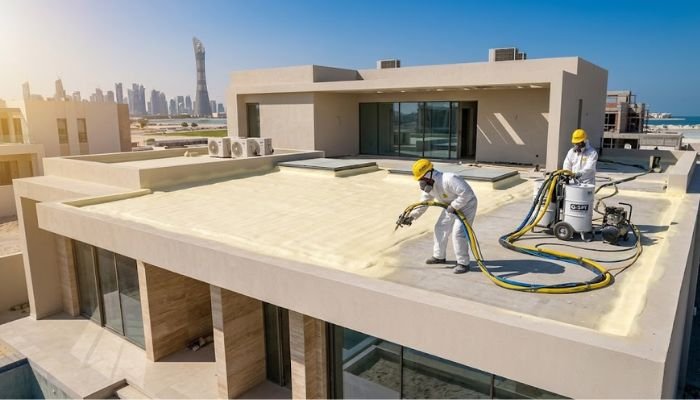
Introduction: Understanding Thermal Foam Insulation
Thermal foam insulation represents the most effective heat resistant solution available for Qatar’s extreme desert climate. This high-performance insulation foam expands on contact to create seamless thermal barriers that reduce cooling energy consumption by 50-70% compared to uninsulated buildings, while providing air sealing, moisture control, and structural strengthening that traditional insulation materials cannot match.
At Insugreen, we’ve applied insulation foam across thousands of Qatar roofs, walls, and specialized applications, consistently delivering verified energy savings and building performance improvements. This comprehensive guide covers everything you need to know about thermal foam insulation: how it works, types and applications, installation requirements, costs, and long-term performance in Qatar’s challenging environment.
Whether you’re planning new construction, renovating an existing building, or addressing energy efficiency issues, understanding heat resistant foam capabilities ensures you select the optimal solution for maximum thermal performance and return on investment.
What is Thermal Foam Insulation?
Thermal foam insulation (also called insulation foam or heat insulation foam) is a two-component polyurethane system applied as an expanding liquid that creates rigid, heat resistant foam adhering to any surface. The expanding foam fills every gap and cavity, creating monolithic insulation that eliminates thermal bridges and air leakage.
Key Characteristics:
Seamless Application: Unlike board insulation requiring precise fitting, the expanding foam fills all gaps automatically, creating continuous thermal barriers without weak points.
Superior Adhesion: The foam bonds mechanically and chemically to wood, concrete, metal, and other building materials, creating permanent insulation that won’t sag, settle, or detach over time.
Air Sealing Properties: Closed-cell thermal foam creates vapor-tight barriers with air leakage rates below 0.02 L/(s·m²) at 75 Pa pressure differential—essentially eliminating infiltration that accounts for 25-40% of cooling load in conventionally insulated buildings.
Moisture Control: The foam resists water absorption (less than 2% by volume) and functions as a vapor barrier, preventing condensation and moisture accumulation within building assemblies.
Structural Enhancement: High-density heat resistant foam adds racking strength to wall and roof assemblies, improving structural performance—particularly valuable for Qatar buildings subject to intense thermal stress.
Types of Thermal Foam Insulation
Closed-Cell Heat Resistant Foam
Closed-cell foam is the premium option for Qatar applications, offering maximum R-value per inch, air and vapor barrier properties, and structural benefits.
Performance Specifications:
- R-value: 6.0-7.0 per inch (25mm)
- Density: 1.8-2.0 pounds per cubic foot (29-32 kg/m³)
- Compressive strength: 25-40 psi (172-276 kPa)
- Water absorption: Less than 2% by volume
- Air permeability: Essentially zero at proper thickness
- Vapor permeance: 1.0-1.5 perms at 2 inches (class II vapor retarder)
Optimal Applications:
- Roof deck insulation (most common Qatar application)
- Exterior wall insulation where maximum R-value needed
- Below-grade applications requiring moisture resistance
- Unvented attic assemblies
- Refrigerated spaces and cold storage
Advantages:
- Highest R-value per inch of any insulation type
- Creates air and vapor barrier in single application
- Adds structural rigidity to assemblies
- Resists moisture intrusion
- Long service life (50+ years) with no performance degradation
Cost: 80-140 QAR/m² for typical roof application (75-100mm thickness)
Open-Cell Insulation Foam
Open-cell foam offers lower R-value but provides excellent air sealing and sound control at reduced cost compared to closed-cell.
Performance Specifications:
- R-value: 3.5-3.8 per inch (25mm)
- Density: 0.4-0.6 pounds per cubic foot (6-10 kg/m³)
- Compressive strength: 3-5 psi (21-34 kPa)
- Water absorption: 15-20% by volume (requires separate vapor barrier)
- Air permeability: Excellent air seal at proper thickness
- Vapor permeance: 10-15 perms at 5.5 inches (semi-permeable)
Optimal Applications:
- Interior partition walls for sound control
- Vented attic insulation between rafters
- Budget-conscious projects where space permits thicker insulation
- Applications requiring vapor permeability
Advantages:
- Lower cost (50-90 QAR/m²)
- Better sound absorption than closed-cell
- Allows vapor diffusion (can be beneficial in some assemblies)
- Uses less material per board foot of coverage
Qatar Application: Open-cell foam is rarely optimal for Qatar buildings. The climate demands maximum R-value and vapor barrier properties that closed-cell provides. Most Qatar projects specify closed-cell thermal foam exclusively.
How Thermal Foam Insulation Works in Qatar Climate
Thermal Resistance
Qatar’s primary challenge is extreme solar heat gain creating massive cooling loads. Heat resistant foam addresses this through exceptional thermal resistance.
Roof Heat Gain Without Insulation:
- Exterior roof surface temperature: 70-80°C in summer sun
- Concrete deck temperature: 60-65°C
- Radiant heat transfer to interior: 200-300 W/m²
- Interior ceiling temperature: 35-40°C
- Result: Massive cooling load, uncomfortable spaces
Roof Heat Gain With Closed-Cell Thermal Foam (100mm):
- Exterior surface temperature: 70-80°C (unchanged)
- Foam exterior surface: 70-75°C
- Foam interior surface: 28-32°C
- Concrete deck temperature: 26-30°C
- Radiant heat transfer: 40-60 W/m² (80% reduction)
- Interior ceiling temperature: 24-26°C
- Result: Dramatically reduced cooling load, comfortable interior
The foam’s low thermal conductivity (0.020-0.024 W/(m·K)) creates temperature gradient across its thickness, preventing heat from reaching the building interior.
Air Sealing
Air infiltration through building envelope gaps can account for 25-40% of cooling energy consumption. Heat insulation foam eliminates this loss.
Common Air Leakage Paths:
- Roof deck penetrations (pipes, vents, equipment)
- Wall-to-roof connections
- Window and door perimeters
- Electrical and plumbing penetrations
- Construction joints and seams
Thermal Foam Solution: The expanding foam fills and seals all these gaps, creating essentially airtight envelope. Blower door testing of buildings with insulation foam shows air changes per hour at 50 Pa pressure (ACH50) of 1.5-2.5, compared to 5-8 ACH50 for conventionally insulated buildings.
Energy Impact: Eliminating air infiltration reduces cooling loads by 20-35% beyond the benefit of thermal resistance alone. Combined effect achieves 50-70% total cooling energy reduction.
Moisture Control
Qatar’s high humidity (60-90% in coastal areas) creates condensation risk when cool interior air meets warm building envelope. Heat resistant foam prevents this.
Condensation Risk: In conventionally insulated buildings, air-conditioned interior air at 24°C and 50% RH has dew point around 13°C. If this air infiltrates into wall or roof cavity where surface temperature exceeds 13°C, condensation occurs, leading to mold, material degradation, and insulation failure.
Foam Protection: Closed-cell foam’s vapor impermeability prevents interior moisture from reaching warm surfaces where condensation would occur. The foam also warms the interior surface of the structural deck above dew point temperature, eliminating condensation even if minor moisture migration occurs.
Thermal Foam Insulation Applications
Roof Deck Insulation (Primary Qatar Application)
Roof deck thermal foam insulation is the most cost-effective building improvement in Qatar, typically reducing cooling energy by 30-50% with payback periods of 3-5 years.
Application Method:
- Clean concrete roof deck removing dust, debris, loose material
- Repair any cracks or damage in concrete
- Prime surface if excessively porous or dusty
- Apply closed-cell foam in multiple passes achieving 75-150mm total thickness
- Apply protective coating if foam will be exposed to UV or foot traffic
Thickness Recommendations:
- Minimum: 75mm (R-18 to R-21) – basic improvement
- Standard: 100mm (R-24 to R-28) – optimal cost/performance
- Premium: 150mm (R-36 to R-42) – maximum performance for high-value buildings
Performance Results:
- 75mm foam: 35-45% cooling energy reduction
- 100mm foam: 45-55% cooling energy reduction
- 150mm foam: 55-65% cooling energy reduction
Cost Analysis (100mm application):
- Material and installation: 110-140 QAR/m²
- Typical villa roof (200m²): 22,000-28,000 QAR
- Annual energy savings: 6,000-9,000 QAR
- Simple payback: 2.4-4.7 years
- 20-year net benefit: 92,000-152,000 QAR
Unvented Attic Systems
Traditional vented attics in Qatar are extremely hot (60-70°C), making HVAC equipment and ductwork in these spaces highly inefficient. Thermal foam creates conditioned attic space.
Installation:
- Apply closed-cell heat resistant foam directly to underside of roof deck
- Typical thickness: 75-125mm depending on performance target
- Seal all soffit vents creating unvented attic
- Attic becomes semi-conditioned space (28-32°C) rather than extremely hot (60-70°C)
Benefits:
- HVAC equipment operates 30-40% more efficiently in cooler environment
- Duct losses reduced by 60-80%
- Additional conditioned storage space created
- Roof structure protected from extreme temperatures
Cost Premium vs. Conventional: 15-25% higher initial cost, recovered through energy savings in 4-6 years
Wall Insulation
Thermal foam wall insulation is less common in Qatar than roof applications due to higher cost, but provides excellent performance for premium buildings.
Exterior Application:
- Apply insulation foam to exterior of masonry/concrete walls
- Covered with cement board, stucco, or other cladding
- Creates continuous insulation eliminating thermal bridges
- Thickness: 50-75mm typical
Interior Application:
- Applied between furring strips on interior wall surface
- Covered with gypsum board or other interior finish
- Reduces interior space by wall thickness plus foam
- Thickness: 50-75mm typical
Cost: 90-130 QAR/m² installed, making EPS board systems more economical for walls in most cases. Thermal foam walls make sense for:
- Renovation where exterior access difficult
- Complex wall geometries where board installation challenging
- Premium projects prioritizing maximum performance
Specialized Applications
Cold Storage and Refrigeration:
- Requires 150-300mm thickness
- Achieves R-36 to R-60+ thermal resistance
- Eliminates vapor drive and condensation issues
- American foam insulation products optimized for these applications
Foundation and Below-Grade:
- Closed-cell foam resists water and provides insulation
- Protects waterproofing membranes
- Typical thickness: 50-75mm
Pipes and Mechanical Equipment:
- Heat insulation foam can insulate complex pipe configurations
- Eliminates thermal bridging at supports and fittings
- Provides excellent efficiency for chilled water systems
Installation Process for Thermal Foam
Surface Preparation
Proper substrate preparation is critical for foam adhesion and long-term performance.
Substrate Requirements:
- Structurally sound and stable
- Clean (no dust, oil, efflorescence, or loose material)
- Dry (moisture content below 19% by weight)
- Temperature within application range (10-40°C)
Preparation Steps:
- Pressure wash roof deck removing all loose material
- Allow complete drying (minimum 24 hours, longer if needed)
- Repair any cracks or damage in concrete
- Prime highly porous or dusty surfaces
- Mask areas not to be insulated
Common Issues: Inadequate cleaning or drying accounts for 70% of thermal foam adhesion failures. Professional companies understand proper preparation requirements.
Application Technique
Insulation foam application requires specialized equipment and trained technicians.
Equipment:
- High-pressure dual-component application system
- Heated hoses maintaining 50-60°C material temperature
- Proportioning pumps ensuring precise mix ratio
- Application gun with mixing chamber
- Personal protective equipment
Application Method:
- Foam applied in multiple passes (lifts)
- Each pass: 20-40mm thick
- Wait 30-60 seconds between passes for foam to rise and cure
- Continue until desired total thickness achieved
- Final surface should be relatively smooth and uniform
Quality Control:
- Monitor mix ratio continuously (improper ratio causes soft foam or shrinkage)
- Verify proper thickness with measuring probes
- Check for missed spots or thin areas
- Test cure by finger pressure (properly cured foam resists indentation)
Environmental Conditions:
- Ambient temperature: 15-35°C optimal
- Substrate temperature: 10-40°C
- Humidity: Below 85% RH
- Wind: Less than 25 km/h (application drift concerns)
Post-Application Protection
UV Protection: Polyurethane foam degrades under UV exposure. If foam will be exposed to sunlight, apply protective coating within 30-60 days of installation.
Coating Options:
- Elastomeric roof coating (most common)
- Acrylic coating
- Silicone coating
- Protective panels or ballast
Foot Traffic: For roofs with regular access, install walkway pads or protective panels. High-density closed-cell foam resists occasional traffic but benefits from protection in high-use areas.
Performance and Durability of Heat Resistant Foam
Long-Term Thermal Performance
Unlike some foam insulations that experience thermal drift (R-value loss over time), properly installed polyurethane foam maintains its rated R-value indefinitely.
Performance Stability:
- Closed-cell foam: No R-value loss over 50+ year service life
- Open-cell foam: Minimal loss (less than 5% over 20 years)
- Unlike XPS or polyiso foam, no blowing agent escape causing R-value reduction
Field Performance: Independent testing of thermal foam installed 15-25 years ago shows thermal performance within 2-3% of original rated values.
Durability in Qatar Climate
Temperature Cycling: Qatar’s daily temperature swing (20-30°C) creates expansion/contraction stress. The foam’s flexibility and adhesion prevent delamination or cracking that affects rigid board systems.
UV Resistance: Unprotected polyurethane foam degrades under UV exposure, losing 1-2mm surface thickness per year. Protected foam (coated or covered) shows no UV degradation even after 30+ years.
Moisture Resistance: Closed-cell foam resists water absorption and does not support mold growth. In flooded conditions, foam can be dried and retains full insulation value.
Chemical Stability: Polyurethane chemistry is highly stable. No breakdown from atmospheric pollutants or salt exposure in coastal areas.
Expected Service Life: 50+ years for protected installations, longer than typical building service life.
Costs and Return on Investment
Material and Installation Costs
Closed-Cell Heat Resistant Foam:
- Material cost: 45-75 QAR/m² for 75mm thickness
- Installation labor: 35-65 QAR/m²
- Total installed: 80-140 QAR/m² depending on thickness, project size, access
Open-Cell Insulation Foam:
- Material cost: 25-45 QAR/m² for 150mm thickness (equivalent R-value)
- Installation labor: 25-45 QAR/m²
- Total installed: 50-90 QAR/m²
Project Size Impact:
- Small projects (under 100m²): Higher per-m² cost
- Medium projects (100-500m²): Standard pricing
- Large projects (500m²+): Volume discounts available
Return on Investment
Typical Qatar Villa (200m² roof, 100mm closed-cell foam):
Investment: 22,000-28,000 QAR
Annual Energy Savings:
- Baseline summer cooling: 5,500 kWh/month × 7 months = 38,500 kWh
- Post-insulation cooling: 2,500 kWh/month × 7 months = 17,500 kWh
- Annual kWh saved: 21,000 kWh
- Annual cost savings: 6,000-8,500 QAR (depending on tariff bracket)
Financial Metrics:
- Simple payback: 2.6-4.7 years
- 10-year cumulative savings: 60,000-85,000 QAR
- 20-year net benefit: 120,000-170,000 QAR
- Internal rate of return: 18-28%
Additional Benefits (Not Quantified Above):
- Improved comfort and indoor air quality
- Extended HVAC equipment life (reduced operating hours)
- Increased property value
- Reduced maintenance costs
Cost Comparison to Alternatives
- EPS cost: 35-60 QAR/m² for equivalent R-value
- Thermal foam premium: 30-80 QAR/m²
- Foam advantages justify premium for roof applications: air sealing, no gaps, adheres to any surface, no fasteners
- Fiberglass batts: 20-35 QAR/m²
- Thermal foam premium: 60-120 QAR/m²
- Foam delivers 40-60% better energy savings despite higher cost
Frequently Asked Questions
Q: What is thermal foam insulation and why is it important in Qatar?
Thermal foam insulation (also called heat resistant foam or insulation foam) is an expanding polyurethane material that creates seamless thermal barriers, reducing heat transfer between building interiors and Qatar’s extreme environment. In Qatar’s climate with outdoor temperatures exceeding 45°C and roof surface temperatures reaching 70-80°C, thermal foam insulation is essential for maintaining comfortable interior temperatures and controlling cooling costs. Without proper insulation foam, buildings require 2-3 times more cooling energy, resulting in monthly electricity bills of 1,200-2,000 QAR for typical villas. High-performance heat insulation foam reduces these costs by 50-70%, typically saving 600-1,400 QAR per month during summer while dramatically improving indoor comfort.
Q: What are the best thermal foam materials for Qatar climate?
For Qatar’s extreme heat and humidity, closed-cell polyurethane foam is the optimal thermal insulation material for roofs. Its combination of highest R-value per inch (R-6 to R-7), seamless air sealing, vapor barrier properties, and resistance to moisture makes it ideal for roof applications where maximum performance is needed. The heat resistant foam creates continuous thermal barriers that eliminate the weak points found in board insulation systems. For walls where cost is more constrained, expanded polystyrene (EPS) board provides excellent value at 40-60% lower cost than thermal foam while still delivering R-4 per inch thermal resistance. The key is matching insulation type to application: heat insulation foam for roofs and complex surfaces, EPS boards for flat walls, and specialized high-performance products like American foam insulation for demanding applications like cold storage.
Q: How much does thermal foam insulation cost in Qatar?
Thermal foam insulation costs in Qatar vary by foam type and application. Closed-cell heat resistant foam for roofs costs 80-140 QAR/m² installed for 75-100mm thickness. Open-cell insulation foam costs 50-90 QAR/m² for equivalent thermal resistance but is rarely used in Qatar’s climate. For a typical 300m² villa, complete building envelope insulation (roof and walls) costs 45,000-75,000 QAR when combining thermal foam for roofs with EPS board systems for walls. While this represents significant upfront investment, energy savings of 6,000-12,000 QAR annually provide payback in 4-7 years, followed by 20-30 years of continued savings. Working with experienced thermal insulation companies in Qatar ensures proper installation that delivers full performance and longevity.
Why Choose Professional Installation
Technical Expertise Required
Thermal foam application is not a DIY project. The chemistry, equipment, and technique require specialized training and experience.
Critical Skills:
- Understanding foam chemistry and proper mix ratios
- Equipment operation and maintenance
- Surface preparation and priming
- Multi-pass application technique
- Quality verification and testing
- Safety procedures and protective equipment use
Consequences of Poor Installation:
- Improper mix ratios produce soft foam or excessive shrinkage
- Inadequate preparation causes adhesion failure
- Poor technique creates thin spots and gaps
- Wrong environmental conditions prevent proper curing
A qualified contractor delivers systems that perform as designed for 50+ years. Amateur installation often fails within 5-10 years, requiring expensive remediation.
Safety Considerations
Heat insulation foam chemicals require proper handling and personal protective equipment.
Health and Safety:
- Components are respiratory sensitizers requiring proper ventilation
- Installers must wear full protective gear including respirators
- Building occupants should vacate during application
- Proper ventilation required for 24-48 hours after application
- Professional contractors maintain all required safety protocols
Conclusion: Maximizing Value from Thermal Foam Insulation
Thermal foam insulation represents the highest-performance heat resistant solution available for Qatar buildings, delivering 50-70% cooling energy reductions that translate to 600-1,400 QAR monthly savings during summer. The seamless application, air sealing properties, and exceptional R-value per inch make insulation foam the optimal choice for roof deck insulation in Qatar’s extreme climate.
While heat resistant foam costs 80-140 QAR/m² installed compared to 35-60 QAR/m² for EPS board alternatives, the performance advantages justify the premium for roof applications. The investment pays back in 3-5 years through energy savings, then continues delivering benefits for 50+ years of service life.
Success requires professional installation by trained contractors using proper equipment, materials, and techniques. For applications requiring traditional application methods, spray foam insulation provides additional options. Work with experienced companies like Insugreen who understand Qatar building requirements and have proven track records of successful projects.
Contact Insugreen today for thermal foam insulation consultation and detailed proposal. We’ll assess your building, explain recommended solutions, and provide transparent pricing showing expected costs and energy savings.
Visit our services page to explore our complete range of insulation solutions, or review our project portfolio to see completed installations across Qatar.