
Introduction: Understanding Thermal Insulation Materials
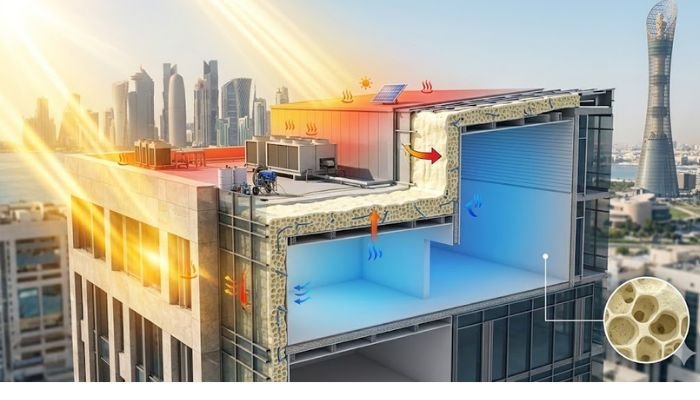
Thermal insulation materials reduce heat transfer between building interiors and the extreme Qatar environment, where summer temperatures exceed 45°C and roof surfaces reach 70-80°C. The right insulation material can reduce cooling energy consumption by 50-70%, translating to monthly savings of 600-1,400 QAR during summer months while dramatically improving indoor comfort.
At Insugreen, we’ve evaluated and installed every major thermal insulation material type across thousands of Qatar projects. This comprehensive guide examines all available insulation materials, their properties and applications, and explains why thermal foam—particularly spray polyurethane foam—represents the optimal choice for most Qatar building applications.
Whether you’re planning new construction or renovating existing buildings, understanding thermal insulation materials ensures you select solutions that deliver maximum energy savings and long-term performance in Qatar’s demanding climate.
What Are Thermal Insulation Materials?
Thermal insulation materials are products specifically engineered to resist heat transfer through building envelopes. They work by trapping air in cellular structures (foam materials), fibrous matrices (fiberglass, mineral wool), or reflective surfaces (radiant barriers), creating resistance to conductive, convective, and radiant heat flow.
Key Performance Metric: R-Value (thermal resistance) measures insulation effectiveness. Higher R-values indicate better insulation performance. Qatar buildings typically require R-15 to R-30 for roofs and R-12 to R-20 for walls to achieve optimal energy efficiency.
Material Categories:
- Foam insulation materials (spray foam, rigid foam boards)
- Fibrous insulation materials (fiberglass, mineral wool)
- Reflective insulation materials (radiant barriers, foil-faced products)
- Innovative materials (aerogel, vacuum panels)
Complete List of Thermal Insulation Materials
1. Spray Polyurethane Foam (SPF)
Type: Foam insulation material applied as expanding liquid
R-Value: 6.0-7.0 per inch (closed-cell), 3.5-3.8 per inch (open-cell)
Density: 1.8-2.0 lb/ft³ (closed-cell), 0.4-0.6 lb/ft³ (open-cell)
Properties:
- Highest R-value per inch of common insulation materials
- Seamless application fills all gaps and cavities
- Creates air and vapor barrier (closed-cell type)
- Adheres to any surface creating monolithic insulation
- Adds structural rigidity to assemblies
- No settling, sagging, or degradation over time
- 50+ year service life with no performance loss
Best Applications in Qatar:
- Roof deck insulation (most common and effective application)
- Complex surfaces and irregular cavities
- Unvented attic systems
- Below-grade applications
- Cold storage facilities
Cost: 80-140 QAR/m² installed for typical 75-100mm roof application
Why Thermal Foam Excels: Spray foam insulation combines highest R-value, air sealing, vapor control, and structural benefits in single application. For Qatar roofs where maximum performance is needed, thermal foam delivers unmatched results.
2. Expanded Polystyrene (EPS) Board
Type: Rigid foam board manufactured from expanded polystyrene beads
R-Value: 3.8-4.2 per inch depending on density
Density: 10-35 kg/m³ (different grades for different applications)
Properties:
- Cost-effective rigid insulation material
- Consistent thermal performance (no R-value drift)
- Lightweight and easy to handle
- Can be cut precisely to fit any space
- Breathable (allows vapor diffusion)
- 100% recyclable
- Does not support mold growth
- 50+ year lifespan when protected from UV
Best Applications in Qatar:
- External wall insulation with EIFS systems
- Under-slab insulation
- Foundation perimeter insulation
- Cavity wall insulation
- Large flat surfaces where board installation practical
Cost: 35-60 QAR/m² installed for typical wall application
Why EPS Works Well: For walls where cost matters and surfaces are relatively flat, expanded polystyrene delivers excellent R-4+ performance at 40-60% lower cost than spray foam. The breathability prevents moisture accumulation issues common in humid climates.
3. Extruded Polystyrene (XPS) Board
Type: Rigid foam board produced through continuous extrusion process
R-Value: 5.0 per inch
Density: 28-45 kg/m³
Properties:
- Higher R-value per inch than EPS
- Superior moisture resistance (less than 1% water absorption)
- Higher compressive strength than EPS
- Blue, pink, or green color from manufacturing process
- Vapor barrier properties
- More expensive than EPS (30-50% cost premium)
Best Applications in Qatar:
- Below-grade applications where moisture resistance critical
- Under-slab insulation where high compressive strength needed
- Inverted roof membranes
- Plaza decks and parking structures
Cost: 55-90 QAR/m² installed
Qatar Application: XPS’s higher cost is justified only when superior moisture resistance or compressive strength required. For most above-grade applications, EPS or spray foam provide better value.
4. Polyisocyanurate (Polyiso) Board
Type: Rigid foam board with highest R-value per inch of board materials
R-Value: 6.0-7.0 per inch (similar to closed-cell spray foam)
Properties:
- Thin insulation achieves high R-values
- Often foil-faced providing vapor barrier and radiant barrier
- More expensive than EPS or XPS
- Can experience thermal drift (R-value loss) in extreme heat
- Temperature-dependent performance (R-value decreases above 50°C)
Best Applications:
- Space-constrained applications
- Roofs in moderate climates
Qatar Consideration: Polyiso’s temperature-dependent performance makes it less ideal for Qatar’s extreme roof temperatures (70-80°C). Spray foam or EPS provide more reliable performance.
5. Fiberglass Insulation
Type: Fibrous insulation made from spun glass fibers
R-Value: 2.9-3.8 per inch depending on density
Forms: Batts, rolls, loose-fill, rigid boards
Properties:
- Lowest cost insulation material
- Easy DIY installation (batts and rolls)
- Non-combustible (Class A fire rating)
- Does not absorb water but loses R-value when wet
- Can settle over time reducing effective R-value
- Requires separate air and vapor barriers
- Skin and respiratory irritant during installation
Best Applications:
- Vented attic floors (loose-fill over ceiling)
- Interior partition walls
- Budget-constrained projects
Qatar Limitations:
- Lower R-value per inch requires thicker insulation
- Air gaps reduce effectiveness significantly
- Moisture from humidity can temporarily reduce performance
- Does not provide air sealing (major source of heat gain)
- Settling over time creates gaps
Fiberglass works for basic insulation on budgets, but delivers 40-60% less energy savings than foam materials in Qatar climate.
Cost: 20-40 QAR/m² installed
6. Mineral Wool (Rock Wool) Insulation
Type: Fibrous insulation made from molten rock or slag
R-Value: 3.0-3.5 per inch
Forms: Batts, boards, loose-fill
Properties:
- Non-combustible (melting point 1000°C+)
- Better sound absorption than fiberglass
- Resists water better than fiberglass
- Higher density provides better air sealing than fiberglass
- More expensive than fiberglass
- Heavier and more difficult to install
Best Applications:
- Fire-rated assemblies
- Sound control applications
- Exterior insulation where fire rating required
Qatar Application: Higher cost than EPS foam with lower R-value per inch makes mineral wool less economical for standard applications. Use only when fire rating or acoustic performance is priority.
Cost: 45-75 QAR/m² installed
7. Reflective Insulation and Radiant Barriers
Type: Aluminum foil products reflecting radiant heat
R-Value: Not rated by R-value; effectiveness depends on installation
Properties:
- Reflects 90-97% of radiant heat
- Extremely thin and lightweight
- Requires air space to function (must face air gap)
- No insulation value without proper installation
- Can reduce radiant heat gain by 30-40%
- Low cost
Best Applications in Qatar:
- Supplement to other insulation in attics
- Reflective roof coatings over foam insulation
- Vehicle insulation
Limitations: Radiant barriers address only radiant heat transfer (not conduction or convection). They cannot replace proper insulation materials. In Qatar buildings, radiant barriers might supplement foam insulation but cannot substitute for it.
Cost: 15-30 QAR/m² installed
8. Aerogel Insulation
Type: Advanced synthetic material with extremely low thermal conductivity
R-Value: 10-20 per inch (highest of any insulation material)
Properties:
- Thinnest insulation for given R-value
- Hydrophobic (repels water)
- Breathable
- Extremely expensive
- Fragile and requires careful handling
Applications: Space-constrained retrofits, high-performance specialty applications
Qatar Reality: Cost of 300-600 QAR/m² makes aerogel impractical for standard buildings. Reserve for situations where space absolutely prohibits conventional insulation thickness.
Thermal Insulation Materials in Buildings – Qatar Context
Roof Insulation Materials
Requirement: Qatar roofs need R-20 to R-30 minimum for optimal performance. Surface temperatures of 70-80°C create enormous heat gain without proper insulation.
Best Material Choices:
1st Choice – Closed-Cell Spray Foam:
- 100mm thickness achieves R-24 to R-28
- Seamless application eliminates thermal bridges
- Creates air and vapor barrier
- Cost: 110-140 QAR/m²
- Energy savings: 45-55% roof heat gain reduction
- Best for: All roof types, maximum performance
2nd Choice – EPS Board + Protective Coating:
- 125mm thickness achieves R-20 to R-24
- Lower cost than spray foam
- Requires careful board fitting and sealing
- Cost: 70-100 QAR/m²
- Energy savings: 35-45% roof heat gain reduction
- Best for: Budget-conscious projects, flat roofs
3rd Choice – Loose-Fill Fiberglass (Vented Attic Only):
- 300mm thickness achieves R-18 to R-22
- Only suitable for vented attic floors
- Does not insulate roof deck itself
- Cost: 40-60 QAR/m²
- Energy savings: 25-35% (less than foam due to air leakage)
- Best for: Traditional vented attic construction, limited budgets
Wall Insulation Materials
Requirement: Qatar walls need R-12 to R-20 for optimal performance.
Best Material Choices:
1st Choice – EPS Board in EIFS System:
- 75-100mm thickness achieves R-12 to R-16
- Cost-effective solution
- Includes finished facade
- Cost: 120-180 QAR/m² complete system
- Best for: Most residential and commercial walls
2nd Choice – Spray Foam (Interior or Exterior):
- 50-75mm thickness achieves R-12 to R-21
- Fills irregular cavities perfectly
- More expensive than EPS boards
- Cost: 90-130 QAR/m² insulation only (plus finish)
- Best for: Renovations, complex wall geometries
3rd Choice – Mineral Wool Boards (Fire-Rated Applications):
- 100-125mm thickness achieves R-12 to R-18
- Non-combustible for fire-rated walls
- Cost: 65-95 QAR/m²
- Best for: Buildings requiring fire-rated assemblies
Foundation and Below-Grade Materials
Requirement: Moisture resistance critical, R-8 to R-12 typical.
Best Material: Closed-cell spray foam or XPS boards
- Both resist moisture excellently
- Spray foam: 50-75mm achieves R-12 to R-21
- XPS boards: 75-100mm achieves R-15 to R-20
- Cost: 70-110 QAR/m²
Thermal Insulation Materials for High Temperature Applications
For specialized applications requiring extreme temperature resistance:
Cold Storage (0°C to -25°C):
- Requirement: R-30 to R-60
- Best material: 150-300mm closed-cell spray foam
- Alternative: Multiple layers of high-density XPS or polyiso
- American foam insulation products optimized for these applications
Industrial High-Heat Processes:
- Requirement: Withstand 150-300°C+ process temperatures
- Materials: Mineral wool boards, ceramic fiber, calcium silicate
- These specialized materials fall outside typical building insulation scope
Frequently Asked Questions
What is thermal insulation and why is it important in Qatar?
Thermal insulation is material that resists heat transfer through building envelopes, reducing the amount of heat entering or leaving conditioned spaces. In Qatar’s extreme climate where summer temperatures exceed 45°C and roof surfaces reach 70-80°C, thermal insulation is absolutely essential for maintaining comfortable interior temperatures while controlling energy costs. Without proper insulation, Qatar buildings require 2-3 times more cooling energy, resulting in monthly electricity bills of 1,200-2,000 QAR for typical villas. High-performance insulation materials like spray foam reduce these costs by 50-70%, saving 600-1,400 QAR monthly during summer while dramatically improving indoor comfort and reducing HVAC equipment strain.
What are the best thermal insulation materials for Qatar climate?
For Qatar’s extreme heat and humidity, the best thermal insulation materials are closed-cell spray polyurethane foam for roofs (R-6 to R-7 per inch, seamless application, vapor barrier) and expanded polystyrene (EPS) boards for walls (R-4 per inch, cost-effective, breathable). Spray foam is optimal for roof applications where its highest R-value per inch, air sealing, and moisture control justify the 80-140 QAR/m² cost. For walls, EPS boards deliver excellent R-12 to R-16 performance at 35-60 QAR/m², making them more economical than spray foam for large flat surfaces. The combination of spray foam roofs and EPS walls provides the best balance of performance and value for most Qatar buildings.
How much does thermal insulation cost in Qatar?
Thermal insulation costs in Qatar vary significantly by material type. Spray foam insulation costs 80-140 QAR/m² installed for roofs (75-100mm thickness). EPS board systems cost 35-60 QAR/m² for basic wall insulation, or 120-180 QAR/m² for complete EIFS systems including finished facade. Fiberglass insulation costs 20-40 QAR/m² but delivers significantly less energy savings. For a complete 300m² villa (200m² roof + 280m² walls), expect 45,000-75,000 QAR for comprehensive insulation. While this represents substantial upfront investment, annual energy savings of 6,000-12,000 QAR provide payback in 4-7 years, followed by decades of continued savings.
What is the thermal insulation materials list?
The complete list of thermal insulation materials includes: (1) Spray polyurethane foam – closed-cell and open-cell types offering R-6 to R-7 per inch, (2) Expanded polystyrene (EPS) rigid boards providing R-4 per inch, (3) Extruded polystyrene (XPS) boards offering R-5 per inch, (4) Polyisocyanurate (polyiso) boards providing R-6 to R-7 per inch, (5) Fiberglass insulation in batts, rolls, or loose-fill form offering R-3 to R-4 per inch, (6) Mineral wool (rock wool) insulation providing R-3 to R-3.5 per inch, (7) Reflective insulation and radiant barriers, (8) Aerogel insulation offering R-10 to R-20 per inch for specialty applications. Each material has specific advantages for different applications in Qatar buildings.
What are thermal insulation materials in buildings?
Thermal insulation materials in buildings are products installed within walls, roofs, floors, and foundations to reduce heat transfer between conditioned interior spaces and the external environment. In Qatar buildings, insulation materials serve multiple functions: reducing cooling loads by 50-70% through thermal resistance, preventing air infiltration that accounts for 25-40% of cooling energy, controlling moisture and condensation in humid conditions, and in some cases adding structural rigidity. The most effective building insulation materials for Qatar are spray foam for roofs (seamless application, R-7 per inch) and EPS boards for walls (cost-effective, R-4 per inch). Proper selection and installation of building insulation materials is the single most cost-effective improvement for reducing operating costs and improving comfort in Qatar’s extreme climate.
What are thermal insulation materials for roof?
The best thermal insulation materials for roofs in Qatar are closed-cell spray polyurethane foam (100mm achieving R-24 to R-28) as the premium choice offering maximum performance at 110-140 QAR/m², and EPS foam boards (125mm achieving R-20 to R-24) as the economical alternative at 70-100 QAR/m². Spray foam is optimal because it creates seamless coverage eliminating thermal bridges, adheres directly to any roof deck geometry, provides air and vapor barriers in single application, and adds structural rigidity. For vented attic applications, loose-fill fiberglass (300mm achieving R-18 to R-22) costs only 40-60 QAR/m² but delivers 40% less energy savings due to air leakage. Working with experienced thermal insulation companies in Qatar ensures proper material selection and professional installation.
What are thermal insulation materials for walls?
The best thermal insulation materials for walls in Qatar are expanded polystyrene (EPS) boards (75-100mm thick) installed as part of EIFS external insulation systems at 120-180 QAR/m² complete, or spray polyurethane foam (50-75mm thick) at 90-130 QAR/m² for insulation alone. EPS boards provide excellent cost-performance balance, delivering R-12 to R-16 thermal resistance while including finished weather-resistant facade. Spray foam is preferred for renovation projects where exterior access is difficult, or for walls with complex geometries where board installation is challenging. For fire-rated wall assemblies, mineral wool boards (100-125mm thick) provide R-12 to R-18 with non-combustible properties at 65-95 QAR/m². Interior wall insulation using fiberglass batts (100-150mm thick) costs only 30-50 QAR/m² but requires separate vapor barriers and delivers lower performance due to air gaps.
What are thermal insulation materials for high temperature?
For high-temperature applications in Qatar including cold storage facilities, industrial processes, and specialized equipment, thermal insulation materials must withstand extreme conditions. For cold storage requiring 0°C to -25°C with outside temperatures of 45°C+, closed-cell spray foam at 150-300mm thickness provides R-30 to R-60 thermal resistance while creating vapor-tight barrier preventing condensation. American foam insulation products are specifically formulated for these demanding applications. For industrial high-heat processes above 150°C, specialized materials include mineral wool boards (withstand 1000°C+), ceramic fiber insulation (1200°C+), and calcium silicate insulation (800°C+). These materials provide thermal resistance while maintaining structural integrity at extreme temperatures where standard building insulation materials would fail.
What is the best insulation for Qatar heat?
The best insulation for Qatar heat is closed-cell spray polyurethane foam for roofs, providing R-6 to R-7 per inch, seamless application that eliminates thermal bridges and air leakage, vapor barrier preventing condensation, and 50+ year lifespan with no degradation. For a typical villa with 200m² roof, 100mm spray foam costs 22,000-28,000 QAR installed but reduces summer cooling costs by 45-55%, saving 6,000-9,000 QAR annually with 3-5 year payback. This makes spray foam the most cost-effective roof solution despite higher upfront cost. For walls, expanded polystyrene (EPS) boards provide excellent R-4 per inch performance at 40-60% lower cost, making them optimal for large wall areas. The combination delivers maximum energy savings: spray foam where performance matters most (roofs), EPS where cost-effectiveness is priority (walls).
Why Thermal Foam Tops the List
While this guide has examined all available thermal insulation materials, closed-cell spray polyurethane foam consistently delivers superior results for Qatar roof applications:
Performance Advantages:
- Highest R-value per inch (R-6 to R-7) of practical materials
- Seamless application eliminates thermal bridges reducing other materials’ effectiveness
- Air sealing prevents infiltration accounting for 25-40% of cooling loads
- Vapor barrier controls moisture preventing condensation damage
- Structural benefits add rigidity to roof assemblies
- 50+ year service life with no R-value degradation
Economic Justification: Despite 2-3x higher cost per m² than EPS boards, spray foam delivers 15-25% more energy savings, achieving payback in 3-5 years versus 5-8 years for less expensive alternatives. Over 20-year perspective, spray foam provides 40,000-60,000 QAR greater net benefit than cheaper materials.
Application Versatility: Spray foam adheres to any surface geometry, making it ideal for complex roofs where board installation is impractical. No other material combines thermal foam’s performance, durability, and installation versatility.
Conclusion: Selecting Optimal Thermal Insulation Materials
Success in Qatar’s extreme climate requires matching thermal insulation materials to specific applications. For roofs where 60-70% of cooling load originates, invest in premium closed-cell spray foam insulation delivering maximum R-value and air sealing. For walls, use cost-effective EPS foam boards or complete EIFS systems providing excellent performance at reasonable cost.
Working with experienced thermal insulation companies in Qatar like Insugreen ensures proper material selection, professional installation, and verified energy savings. We provide comprehensive thermal analysis, detailed proposals, and guaranteed performance.
Contact Insugreen today for thermal insulation materials consultation. We’ll assess your building, recommend optimal materials for each application, and provide transparent pricing showing costs and expected savings.
Visit our services page to explore our complete insulation solutions, or review our project portfolio to see successful thermal insulation installations across Qatar.